
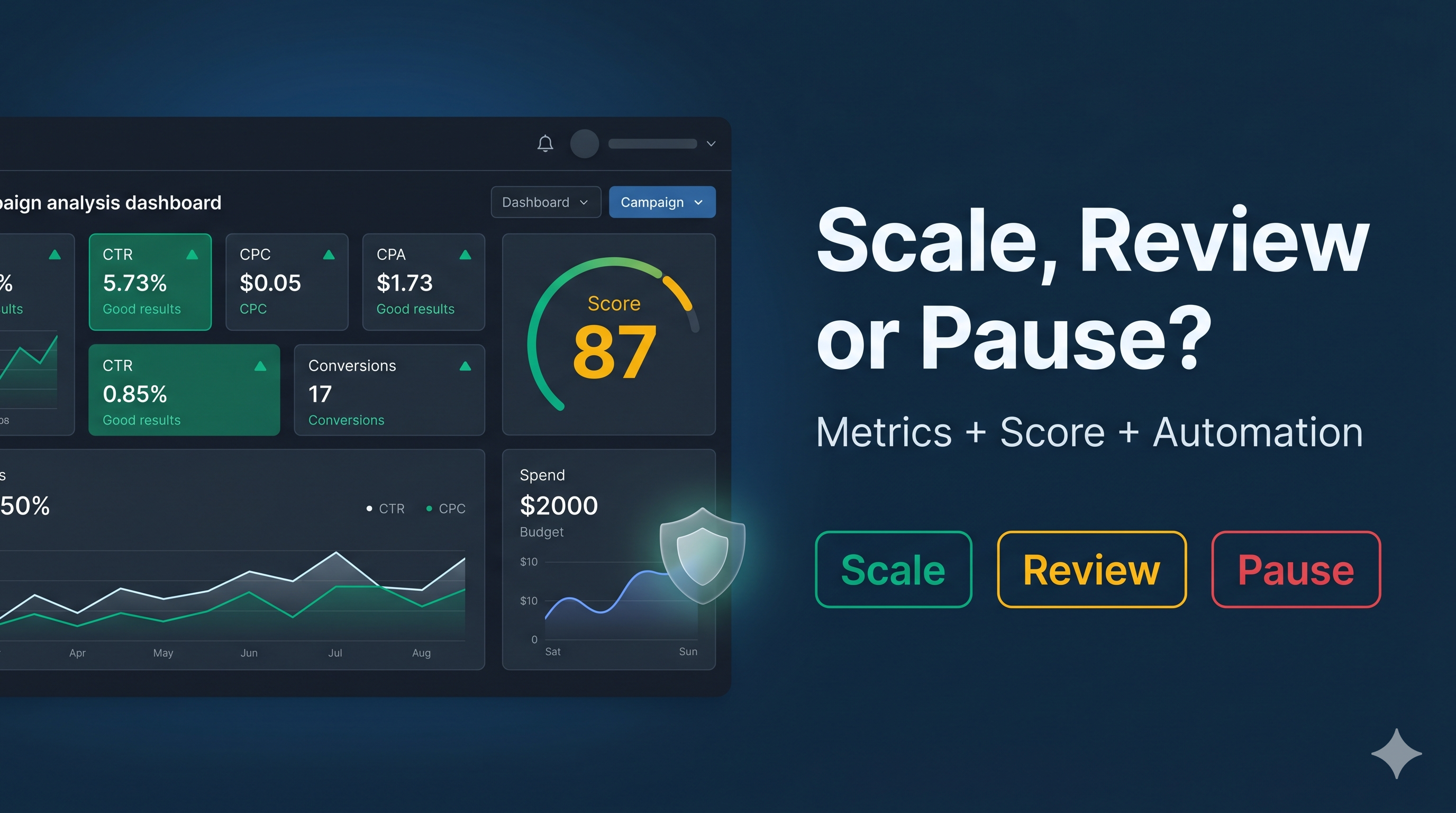
One of the hardest parts of managing Meta Ads campaigns is deciding what to do next.
Should you increase the budget? Should you pause the campaign? Should you change the creative? Should you wait for more data?
These decisions become even harder when you look at isolated metrics. A campaign can have a good CTR and still generate poor conversions. Another campaign can have a higher CPC but produce better business results. And if you wait too long, a weak campaign can spend too much budget before you react.
That is why campaign analysis needs to connect metrics, context, and decision-making.
In this article, you will learn which metrics to use when deciding whether a Meta Ads campaign should be scaled, paused, or adjusted, and how ScoreFlow automations can help analyze performance and protect your ad budget.
Why One Metric Is Not Enough
No single metric tells the whole story.
CTR, CPC, CPA, conversions, spend, budget, and score need to be analyzed together. If you focus on only one number, you can easily make the wrong decision.
For example:
- A low CPC can look good, but it does not mean the campaign is profitable.
- A high CTR can indicate strong attention, but it does not guarantee conversions.
- A high CPA can be a problem, but it may still be acceptable depending on margin and customer value.
- Low conversion volume may indicate a problem, but it can also mean the campaign does not have enough data yet.
The better question is not "is this metric good?"
Does this combination of metrics show that the campaign deserves more budget, needs adjustments, or is putting ad spend at risk?
CTR: The Attention Signal
CTR, or click-through rate, shows the percentage of people who clicked after seeing your ad.
It helps you understand whether the ad is getting attention.
A low CTR can indicate:
- weak creative;
- unclear offer;
- poor audience fit;
- low message relevance;
- ad fatigue.
But a high CTR does not automatically mean the campaign is a winner.
If many people click but very few convert, the problem may be the landing page, the offer, the audience, or the quality of the traffic.
Use CTR as an attention signal, not as the final decision.
CPC: The Cost Of Traffic
CPC shows how much you are paying for each click.
It is useful for understanding the cost of traffic, but it can be misleading when analyzed alone.
A campaign with a low CPC may generate cheap clicks from people who are not ready to buy. Another campaign with a higher CPC may attract a more qualified audience and produce better conversions.
Before making decisions based on CPC, ask:
- Are these clicks turning into conversions?
- Is the cost per result acceptable?
- Is the audience qualified?
- Does the conversion volume justify the traffic cost?
CPC is important, but it should not control the decision by itself.
CPA: The Cost Of The Result
CPA is one of the most important metrics when deciding whether to scale, pause, or adjust a campaign.
CPA shows how much you are paying for a conversion or acquisition.
If CPA is within your target, the campaign may be a candidate for more budget. If CPA is above your acceptable limit, the campaign needs review.
But context matters.
A higher CPA can still be acceptable if:
- the average order value is high;
- the profit margin supports it;
- the lead quality is strong;
- the campaign is still in a learning phase;
- the goal is to generate data for analysis.
A bad CPA becomes dangerous when it comes with high spend, low conversion volume, and a negative trend.
Conversions And Minimum Data Volume
Before pausing or scaling a campaign, you need to check whether there is enough data.
A campaign with low spend and low impressions may not have enough information for a final decision.
On the other hand, if a campaign has already spent a meaningful amount of budget and still has weak results, the risk increases.
Useful questions:
- Has the campaign spent enough to be evaluated?
- Is the conversion volume consistent?
- Are results improving or getting worse over the last few days?
- Is the issue at campaign, ad set, or ad level?
Scaling too early can waste budget. Pausing too early can kill a test that simply needed more data.
Spend And Budget: When Ad Capital Is At Risk
Performance is not just about results. It is also about protecting capital.
A weak campaign that spends very little may simply be part of testing. A weak campaign that spends too much can quickly become a serious problem.
That is why spend needs to be analyzed together with:
- daily budget;
- CPA;
- conversions;
- score;
- recent trend;
- the risk limit defined for the account.
The higher the spend, the more control you need.
This is where a platform with score and automation can be useful. The media buyer should not depend only on memory, spreadsheets, or manual checks to notice that a campaign is burning budget.
Score: How To Prioritize What To Scale, Fix, Or Pause
A campaign score helps turn multiple metrics into a simpler performance reading.
Instead of checking CTR, CPC, CPA, spend, and conversions separately, a score can help create a priority system.
For example
- High score: healthy campaign, possible candidate to maintain or scale.
- Medium score: campaign with some good signals, but needs monitoring.
- Low score: campaign that needs review, adjustment, or possible pause.
Score does not replace the media buyer.
It helps the media buyer decide where to look first.
This becomes especially useful when there are many campaigns, ad sets, and ads running at the same time.
ScoreFlow Automations To Protect Ad Budget
ScoreFlow can help by using automations based on metric rules.
The goal is not to automate everything without judgment. The goal is to create protections so weak campaigns do not spend too much budget before someone notices.
Useful automation examples:
- Alert when a campaign spends above a limit without generating conversions.
- Mark campaigns with CPA above target as a priority for review.
- Highlight campaigns with strong score and consistency as possible scale candidates.
- Detect performance drops in campaigns that used to be healthy.
- Pause or flag assets with critical score when the rule is safe enough.
These automations help protect ad budget because they reduce delays in decision-making.
Instead of discovering too late that a campaign spent too much without results, the media buyer can act faster.
Checklist Before Scaling, Pausing, Or Adjusting
Before making a decision, review:
- Does the campaign have enough data?
- Is the time window appropriate?
- Does CTR show enough attention?
- Is CPC acceptable?
- Is CPA within target?
- Is conversion volume consistent?
- Has spend crossed the risk limit?
- Does the score confirm the metric reading?
- Is the drop temporary or part of a trend?
- Should an automation alert this scenario?
When To Scale
Consider scaling when:
- CPA is within target;
- conversion volume is consistent;
- score is strong;
- spend is controlled;
- recent trend is positive;
- the result is not based on one isolated day.
Scaling does not mean increasing budget blindly. It means increasing exposure based on consistent signals.
When To Adjust
Consider adjusting when:
- CTR is low;
- CPC increased;
- CPA is getting worse;
- conversions dropped;
- score is average;
- there is at least one positive signal, but the campaign is not healthy yet.
Adjustments can involve creative, audience, offer, budget, placement, or landing page.
When To Pause
Consider pausing when:
- spend has passed the acceptable risk limit;
- CPA is far above target;
- conversion volume is weak;
- score is critical;
- the negative trend continues;
- there is no clear adjustment hypothesis.
Pausing is not failure.
In many cases, pausing is how you protect budget and move capital toward campaigns with better potential.
How ScoreFlow Helps
ScoreFlow centralizes campaign, ad set, and ad analysis into a dashboard with metrics, score, budget data, and automations.
In practice, it helps answer three questions:
- What is working and deserves more attention?
- What needs to be reviewed?
- What is putting ad budget at risk?
With score and automations, campaign analysis becomes more organized and less dependent on guesswork.
The media buyer still makes the decision, but now with a clearer view of what deserves action.
Conclusion
Deciding whether a Meta Ads campaign should be scaled, paused, or adjusted requires more than one isolated metric.
CTR, CPC, CPA, conversions, spend, budget, and score need to work together.
When those metrics are organized in a dashboard and supported by automations, it becomes easier to protect budget, reduce waste, and prioritize campaigns with better potential.
ScoreFlow was created to help with exactly that: turning disconnected campaign data into clearer decisions for Meta Ads teams, agencies, and advertisers.